Archive for December, 2006
Newcastle Airport Logo
Hey, merry Xmas!, Newcastle airports logo struck me as looking remarkably like an exploding plane taking off, thought it was worth sharing!

Business Solutions
Fedup with the word “solution” being thrown around like the name of an exclusive bar, I have taken it upon myself to list all the riduclous but genuine solutions submitted by Private Eye readers. Enjoy!
“Pasta Solutions: the ultimate solution to your pasta needs” pasta
“Pain Solutions Ltd: in partnership with Lancashire council NHS” doctors and nurses
“Imperial Place Tailored Leasing Solutions” office rental
“Spirtual High: wholesaler and distributer of drug harm minimisation solutions” legal drugs
“Carmac Solutions Ltd: your solution’s solution” wheelchairs
“Smart Christmas Solutions: the single source solution for christmas shopping” shop
“Amazon Home and Garden great Christmas Gift solutions” presents
“Planet Pursuit Corporate Day : Christmas Solutions” office parties
“Morrisons wrap solutions” wrapping paper
“Hobbycraft solutions for displaynig your christmas cards” ribbons and blu-tack
“Kria Yoga’s Christmas Message: Peaceful Global Solutions” peace on earth
No comments
Sacrifice and Compromise
Last week I was asked to re-animate a website intro for one of our more fickle clients. With fresh photographs and some clever flash 8 effects I set about creating a “scene” for each photo/piece of video. Now complete, the whole animation lasts 93 seconds, a mammoth piece by anyone’s standards, and the MD rightly pointed out this would have to be cut back, probably by as much as half.
Now my answer to this problem would be to cut back on the scenes, remove four completely and maintain (with tweaking) the smooth pace and timing of the remaining four. The MD however will argue for keeping all the scenes (the client paid for the photography) and instead ramping the speed of the whole anim up.
The concept and animation have been designed, shot and animated to capture a dreamlike escapism, and in order to maintain the smooth pace the timing can’t be speeded by x2. A compromise of removing one a scene and speeding everything up will, in my eyes, damage and dilute the original idea. Sacrificing 3 scenes however will mean the integrity of the idea remains intact, at the expensive of some sexy photography.
“Coming to a compromise” is a term clients and execs use far to often. In rare occasions a good compromise can be found, but in my experience a compromise saps the strength of the idea, and brings projects from the realm of the interesting back to the flat line of mediocrity. Sacrificing something for the greater good is always difficult, however I would sooner have my idea held strong over four scenes, than forced over a sped up eight.
Media Agency Guide Update
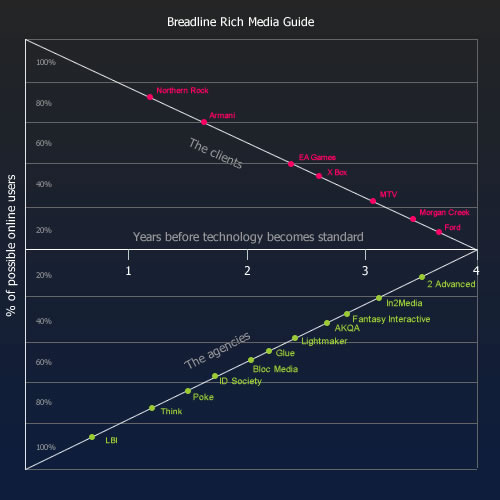
I’ve started populating my media agency guide with clients as well as the agencies. My boss made an interesting observation the other day. He pointed out that as many agencies cover both the rich end of the market as well as the heavy back-end work the guide would be misleading. To rectify this I intend to select one project only for each agency. This will be the one project that I feel best represents the agencies “Cutting Edge” status. I’ll continue to add and refine and put up a more complete version after the Xmas break.
2 comments
Breadline Rich Media Guide
As of early January I’ll be leaving Newcastle, and the website company that taught me all I currently know behind. I’m off to a bigger firm based just south of the bright lights of London, a firm that specialize in the richer end of the online media market. In Newcastle the firm I’m with sell themselves on their technology, providing original design that is accessable to the vast majority of internet users. Being members of the W3C consortium accessability standards are high and, at times stringent. My heart’s in the richer area of media; flashier graphics and animations, at the expense of usability, hence the move.
I’ve long been an admirer of the cutting edge flash studios; 2advanced, Fantasy Interactive and In2Media to name a few. With terms such as “Cutting Edge” getting thrown around by industry spectators all too often, I’ve often wondered “Who is at the cutting edge of online rich media?” The studios I mentioned are pushing the boundaries, but I’ve yet to find a definitive guide to how they all stack up against each other. The NMA Top 100 is a good indication, although its main point of comparison is annual turnover. What I want to know is who’s pushing the front end of rich media the furthest.
To find out I scribbled a graph (featured below) charting a selection of British online design firms, and having examined their front end flash work, tried to place them depending on how far ahead they are in terms of rich media.
Web standards start with those that pioneer. Those that design for the few pave the way for those that will eventually design for the masses. The Adobe flash player is a good example. As of September % of online users with Flash Player 6 in America and Canada was 97% compared with Flash Player 9 which was at 40.3%. The studios that design and export solely in player 9 cut off a large percent of the potential users, but the flipside is they can push online media further, using more advanced graphics, video and actionscript.
The designers and studios pioneering these new techniques create the work that entices users online to upgrade, and then after a certain time what began as fringe technology becomes standard. It’s these pioneers that interest me, and the goal of this guide is to track their position at the front end, and the clients that allow them to do get there.
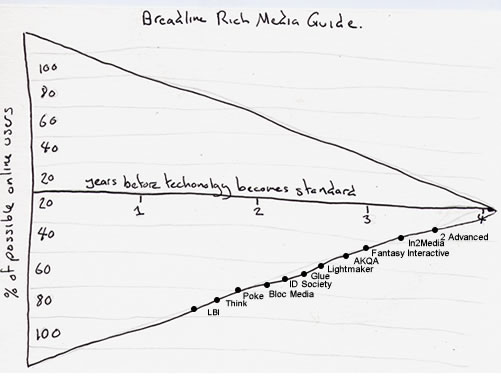
I haven’t worked out an formula for this yet, nor have I got an accurate time frame sorted. I just dive on the studios website, see how good their rich media is (normally flash) then place them on the graph in comparison to the rest. I’ll add more accurate information and stats as I refine the guide.
2 commentsHeavy/Light Logos
Recently on Logopond a debate started about the use of heavy and light typefaces side by side, eg “BreadlineDesign”. It struck me that this is becoming a bit of a trend amongst designers, and as a result is being used a little to frequently.
There are times when using this technique is a sweet solution to logo problems, especially when the logo has to be executed online. For many businesses the website is the first point of contact for new customers, so if the logo looks like a URL by minimizing gaps, then the person that sees it will make the mental leap from brand to website faster.
Obviously putting two words immediately next to each other is gonna churn up legibility issues, so differentiating the two is gonna be a priority, and if making one word heavier than the next solves this problem quickly then its gonna be used regularly by designers.
The problem I have with this, is that I get the impression bolding off the first word is used to make the logo look pretty first, and is only justified when the designer is pressed for a reason and been given five minutes to make one up.
Trends in design come and go, the 3D logo came and went, the Web 2.0 gel effect is in vogue just now, and the heavy/light typeface technique seems to be here to stay for a time to. The one constant is the clients need for good original design, and if the clients are shelling out big bucks for a logo, I believe offering them a solution without clear justification sells both client and designer short.
No commentsVray Bedroom
Ok not a tutorial, I’ll do my first proper one next weekend, in the meantime I’ve uploaded a scene that I never quite finished. Feel free to download it and take it to pieces. Its set up for a V-Ray render. If you need any of the models for commerical purposes feel free to use ‘em, but please let us know first!
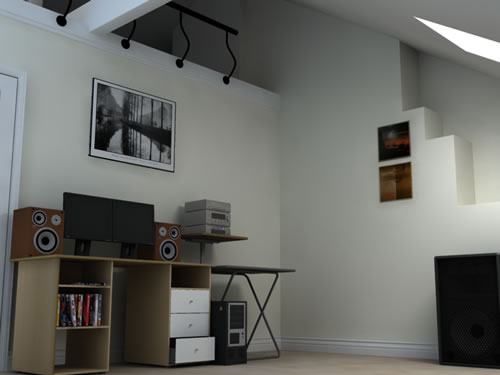
Scene Download
And if you do a great job, let us know!
No comments
Mastercard Re-Brand
Hot on the heels of the recent Visa re-brand, Mastercard International have taken it upon themselves to update their logo and change their name to Mastercard Worldwide. According to Mastercard:
“The three circles of the new corporate logo build on the familiar interlocking red and yellow circles of the MasterCard consumer brand, and reflect the company’s unique, three-tiered business model as a franchisor, processor and advisor.”
Hmmm, to be honest, I don’t really get it. The logo must surely be aimed at the end user, i.e. the consumer and I can’t really see why they would be interested in a “unique, three-tiered business model”. From a professional perspective, it looks like they’ve jumped on the glossy web 2.0 logo bandwagon. From an amateur perspective, it looks like a tumour growing out of an iconic brand.
Don’t get me wrong, I’m an advocate of old brands embracing the modern age. Visa’s re-brand brought a drab identity smoothly into the 21st century, but Mastercard seem to have embraced decoration over design, and may well suffer for it in the long run.
No comments