Breadline Rich Media Guide
As of early January I’ll be leaving Newcastle, and the website company that taught me all I currently know behind. I’m off to a bigger firm based just south of the bright lights of London, a firm that specialize in the richer end of the online media market. In Newcastle the firm I’m with sell themselves on their technology, providing original design that is accessable to the vast majority of internet users. Being members of the W3C consortium accessability standards are high and, at times stringent. My heart’s in the richer area of media; flashier graphics and animations, at the expense of usability, hence the move.
I’ve long been an admirer of the cutting edge flash studios; 2advanced, Fantasy Interactive and In2Media to name a few. With terms such as “Cutting Edge” getting thrown around by industry spectators all too often, I’ve often wondered “Who is at the cutting edge of online rich media?” The studios I mentioned are pushing the boundaries, but I’ve yet to find a definitive guide to how they all stack up against each other. The NMA Top 100 is a good indication, although its main point of comparison is annual turnover. What I want to know is who’s pushing the front end of rich media the furthest.
To find out I scribbled a graph (featured below) charting a selection of British online design firms, and having examined their front end flash work, tried to place them depending on how far ahead they are in terms of rich media.
Web standards start with those that pioneer. Those that design for the few pave the way for those that will eventually design for the masses. The Adobe flash player is a good example. As of September % of online users with Flash Player 6 in America and Canada was 97% compared with Flash Player 9 which was at 40.3%. The studios that design and export solely in player 9 cut off a large percent of the potential users, but the flipside is they can push online media further, using more advanced graphics, video and actionscript.
The designers and studios pioneering these new techniques create the work that entices users online to upgrade, and then after a certain time what began as fringe technology becomes standard. It’s these pioneers that interest me, and the goal of this guide is to track their position at the front end, and the clients that allow them to do get there.
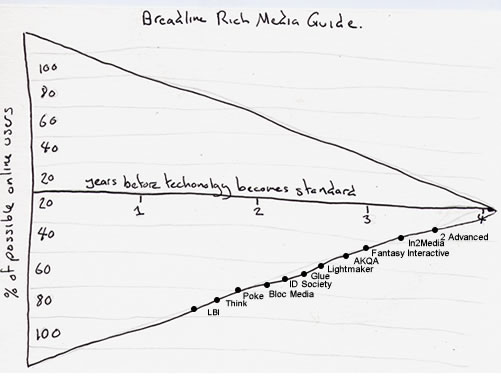
I haven’t worked out an formula for this yet, nor have I got an accurate time frame sorted. I just dive on the studios website, see how good their rich media is (normally flash) then place them on the graph in comparison to the rest. I’ll add more accurate information and stats as I refine the guide.
2 Comments so far
Leave a reply
That’s really insightful. I’d be interested to see what of clients are attracted to agencies across the scale.
I’d imagine a company like Nike doesn’t care that much about web standards and will push boundaries because that fits in with their brand message. However, more conservative organisations appear towards the back of scale.
It would also be interesting to see how much clients are willing to spend at differnet points in the scale.
Yeah thats a good point, knowing where clients fall on the scale would give better meaning to the graph as a whole.
I’ll add clients onto the top part of the graph, the most daring near the front end, most conservative at the back.