Currency Conundrum
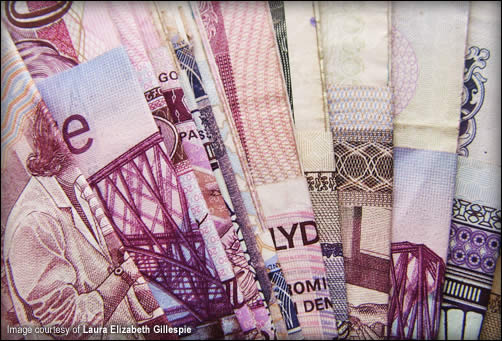
Getting the train from Glasgow to London is always a dull, cramped and frequently sweaty affair, but the anticipation of unloading a wedge of Scottish bank notes on English shops always makes the journey that little more bearable. I look forward to arguing with stubborn store staff who refuse to take our “monopoly money”. It never fails to put a smile on my face.
For those not in the know, Scotland shares the same currency as England (pounds sterling) but unlike our southern friends we have not one bank printing notes but three, and not satisfied with three types of note, each bank produces variations to mark special events or to simply one-up the bank next door. The net result? More than 15 different types of bank note, a selection of them appear here.
I’m proud of Scotland’s individuality and believe a currency distinguished from England’s is a positive thing, however the excessive number of note designs in circulation surely serves to only to dilute national identity, make life easier for fraudsters and confuse the hell out of tourists.
South of the border Scottish currency is viewed with at best with suspicion, and worst flat rejection. The cause isn’t helped much by the law either with Scottish notes not actually being legal tender. It’s a great shame. Scotland already struggles with its identity, being known more for its past and poor health than its fast moving I.T and Medical industries (although rising stars like Andrew Murray and James Mcavoy are helping improve Scotland’s image). A confused currency isn’t Scotland’s only identity problem either, it still has two flags, and can’t decide on a national anthem.
The banks and devolved government need to get on top of currency design. Internationally currency is a nations business card. I can clearly picture an American dollar, could an American clearly picture one of the five Scottish fivers? Unifying currency design plays a small but important role in unifying a nations identity and it be great to see Scotlands updated and standardized, at least until we get the Euro, but that’s a whole other argument…
3 Comments so far
Leave a reply
Brilliant post so true!
‘i think you’ll find pal thats legal tender!’
http://www.youtube.com/watch?v=-zxNTbsU4ns
I understand the first part of your arguement, it is funny about having to tell someone that it’s real and they can accept it!
However your point about the number of different types making it easier to make fake notes is flaud! It makes it harder, like if you change the password to something every 3 or 4 months! Surely if you make a fake English note it’s easier to keep getting rid of them for longer as there not changed as much! And apparently the way notes are printed in England makes it easier to produce forgeries, the one uping your competitor has advantages makes you work harder on the quality!
It’s important to bear in mind that Scottish banknotes are printed by three different banks, all of which can do so due to the 1845 Bank Notes (Scotland) Act. These are the Bank of Scotland, The Royal Bank of Scotland, and Clydesdale. I don’t know much about English banks, and can only assume the majority are building societies, which I don’t believe hold the right to print their own notes - which explains the lack of note variety. Scotland’s banking laws also differ due the countries titanic role in the industrial revolution. Sure you can picture the American Dollar bill, but it’s still relatively young - did it exist in 1845? Besides, they’re pretty patriotic over there, the same can’t be said for here.