Archive for the 'Branding' Category
Launching a brand
Big name high street brands come and go. Some, like Orange seem to go from strength to strength, others like Woolworths seem to just plod along and some, like the now defunct C&A die or leave British shores altogether. To stay ahead of the competition brands must continually evolve and occasionally reinvent themselves. Marks and Spencer are a great example of how a failing high street brand revolutionised its image and turned around profits.
When a big well know organisation re-brands they can of course hard launch their new identity, with much fanfare and promotion (as Marks and Spencers did), or soft launch, gradually making a smooth transition from old to new without alienating existing consumers. Deciding which style of launch shouldn’t be taken lightly; if the Olympic logo had been soft launched the media and public reaction would have been far less venomous than it was.
Often high street re-brands are long overdue. The Car Phone Warehouse has long needed to re-brand, as they are the market leader in high street mobile retail, and yet they don’t sell car phones, nor are their shops warehouses. The name clearly needs changing. Sure enough though, change is afoot, as they are now soft launching “The Phone House” in Britain, having already done so in Europe. What surprises me is how badly this launch is being handled. Several shops have changed their signs yet there is no printed literature, nor reference made on the website. The website itself features both old and new logos on the splash page at www.phonehouse.com yet no mention on www.carphonewarehouse.com . With Phones 4 U aggressively attacking the already saturated mobile market place, The Phone House needs to stop dithering and hard launch as soon as possible.
For all the money and time spent on branding and marketing it’s the consumers who decide which brands succeed and which fail, but if confusion and doubt over identity set in, competitors will be quick to punish. Get the strategy right and the brand will be rewarded with new life, and the company with new profits. Get it wrong and the work to undo the damage could be immense.
For more info on soft and hard launching this article on CRN is well worth a read.
2 commentsWhat’s in a name?
Omnipresent branding is a design must for hardware and electrical manufactures, and marketing departments will go to great lengths to keep the logo and name visible across the units and all related media. The name is obviously crucial as it is the buyers and owners first point of brand association. If you’ve just spent £600 on a new Sony hi-fi you can drop the name in conversation with pride, and those you’re talking to will know the brand even if they know little about the hardware. However it seems that many companies completely ignore the benefits of their brand name when actually naming the products themselves, a prime example of this is Yamaha’s product naming.
I’ve been thinking of putting some home cinema hardware in my living room for a while, and knowing Yamaha have a name for quality audio I thought I’d take a look at their line of AV Receivers. They offer twelve in total, the names of each unit are as follows: RX-V359, RX-V361, RX-V459DAB, RX-V461DAB, RX-V559DAB, RX-N600D, DSP-AX759SE, DSP-AX761, DSP-AX861SE, RX-V1700, RX-V2700 and DSP-Z9, All instantly forgettable and all telling me nothing about the product (the DAB being an exception). It’s even difficult to get an idea of which models are similar but higher spec, I’m guessing the RX-V361 is similar but better and more expensive than the RX-V359, but remembering the numerical difference between 361 and 359 is a chore. Marantz and Rotel are just as bad. If the products had decent names then they would be more memorable, both for when planning a purchase and talking about said purchase with friends. Below is a screen shot of the current product list (on left), and a fictional list (on right) that I believe would serve Yamaha much better.
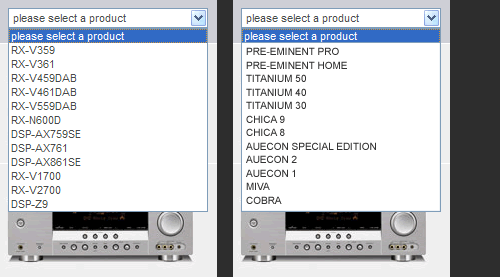
In direct comparison Wharfedale’s range of speakers include the Airedale, the Evo 2, the Diamond 8 and the model up Diamond 9, the Opus and Crystal. These names are cool, sensible and add an intangible value to the product, allowing buyer’s to say “I own a pair of Diamond 9’s”, which makes the huge price tag that more palatable. Change is coming, mobile phones are slowly making the shift to memorable and cool sounding names such as the LG Chocolate and Viewty, the Samsung Viewty and of course the iPhone; their all names my mum can remember come Christmas time.
The iPhone deserves a special mention, as it’s the only mobile I know that actually describes itself in the name, the “i” represents apple without actually stating the name, the “Phone” describing what it is. In fact the iPhone name has transcended the company behind it. People tend to talk about the iPhone, not the Apple iPhone, the need to prefix the manufacture before model is gone. In contrast when talking about Nokia or Samsung phones I instinctively mention the manufacture before the model number, as its often needed just to let the person I’m talking to know the type of phone I’m refereeing to.
Letting engineers name products puts a barrier between the buyer and the brand, but simple, memorable, aspirational product naming goes miles in connecting the brand with both buyer and owner. Addressing poor product naming should be high on any brand strategists list of priorities, and if we as designers can show that there’s more to branding than just logo design, we can raise the value of what we do, and bring some simplicity and old fashioned common sense to the often confusing world of premium manufactured goods.
No comments